Free handbook · EU AI Act

The rules are live.
Are your images?

Article 50 has applied since 2 August 2026. Most fashion teams still cannot say which of their live images involved AI, let alone label them. This handbook shows exactly what to label, what to leave alone, and what to fix before 2 December.

In force since 2 August 2026
24-page handbook, written for fashion e-commerce teams
17 workflows classified, with the wording to publish for each
Placement rules, vendor questions, and the plan to 2 December
Free · 24-page PDFDelivered to your inboxNo spam, ever
Free download

Get the handbook

Enter your work email and we will send the 24-page PDF straight to your inbox.

Work email required. No spam. See our privacy policy.

Where things stand

The AI Act was delayed. Your labelling duty was not.

The Digital Omnibus pushed back the high-risk deadlines in 2026, and a lot of teams read that as breathing room. It left Article 50 untouched.

Applies now
2 August 2026
in force
Transparency duties apply and are enforceable. This includes the visible disclosure you owe shoppers when imagery is AI-generated or AI-manipulated.
Deferred
2 December 2027
high-risk only
The Annex III high-risk obligations that the Omnibus postponed. Not the part that governs your images.
What is inside

A handbook, not a summary of the law

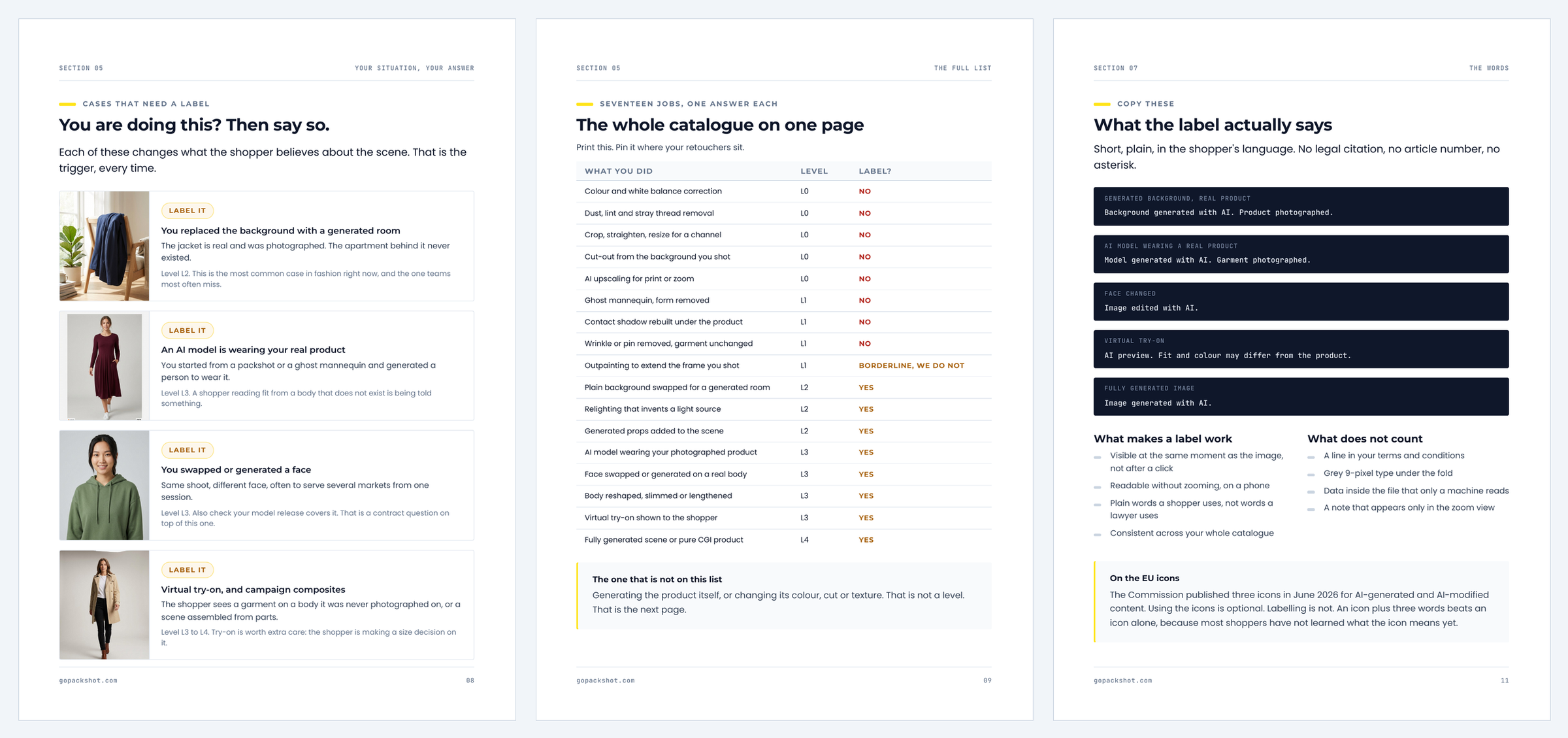
The regulation does not tell you whether an AI background needs a label. This does, for seventeen workflows, with the wording to publish and where to put it.

01
17 workflows, classified
Background swaps, AI models, ghost mannequin, virtual try-on, CGI. Each placed on a five-level ladder with the verdict.
02
The exact wording to publish
Copy-ready disclosure strings per level, plus the four rules that keep them defensible.
03
Where the label goes
Listing, gallery, zoom, ads, email, marketplaces. Surface by surface, with what fails on each.
04
The editing boundary
What counts as standard editing and stays out of scope, and where generative fill crosses the line.
05
Eight ways teams get it wrong
The failure patterns that read as an attempt to disclose without disclosing.
06
Where provenance dies
Your CDN strips Content Credentials by default. The 20-minute test that finds your failure point.
07
Ten questions for your vendor
The questionnaire that separates a partner from a supplier, plus three contract clauses.
08
The plan to 2 December
Sixteen weeks, three phases, and what to do if you only have four.
The most useful parts

Answers, not caveats

Preview of the handbook: the five-level ladder, the workflow catalogue, and label placement rules
The five-level ladder
Place any asset on one of five rungs and read off the duty. Colour correction sits on a different rung to an AI model, and the handbook says which.
Seventeen workflows, ruled on
Ghost mannequin, generated contact shadow, background swap, virtual try-on, pure CGI. Each with a verdict and the reasoning behind it.
Copy-ready label wording
The exact strings to publish per level, and why "enhanced with AI" on a synthetic image is worse than no label at all.
The rule above the rules
AI can change the picture. It must never change the product. Disclosure handles the first. Nothing rescues the second.
Who it is for

Written for the teams that own the images

If your brand sells fashion in the EU and any part of your imagery is touched by AI, this is for you. It is general information, not legal advice, and it says so wherever we are giving our reading rather than quoting the law.
Head of E-commerceHead of ContentHead of DigitalBrand & CreativeFashion e-commerceSport & lifestyle
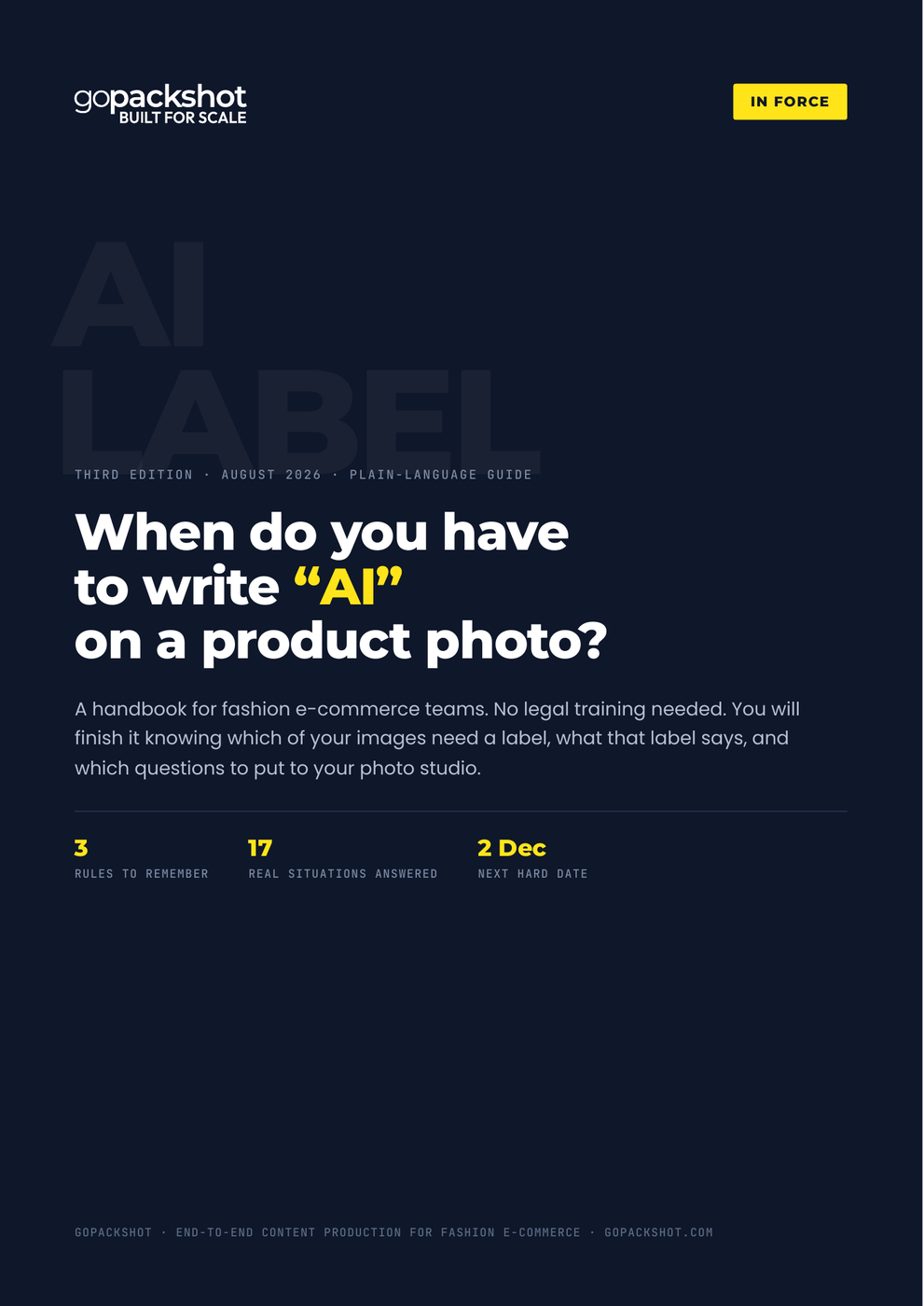
Cover of the handbook: labelling AI product imagery under the EU AI Act

You cannot label what you cannot trace.

Get the handbook and know, workflow by workflow, what your catalogue owes and what to publish on it.